
Will Accounting AI Replace Accountants? What the Evidence Actually Says
The short answer, backed by employment data and firsthand studies of accounting firms, is no: accounting AI is automating the repetitive parts of the job, not the accountant. According to the Bureau of Labor Statistics, employment of accountants and auditors is still projected to grow over the coming decade. Tools that read receipts, categorize transactions, and reconcile accounts are getting very good — but the professional judgment, accountability, and client trust that define an accountant are not on the automation menu.

What is changing is the shape of the role. Routine data entry shrinks; advisory, review, and decision-support grow. This article walks through what AI in accounting can and can’t do, which tasks are genuinely at risk, what the BLS projects for the profession, and how small-business owners and freelancers should think about it. This is general educational information, not tax, accounting, or career advice — consult a licensed CPA for guidance on your specific situation.
The short answer: AI replaces tasks, not accountants
Automation removes tasks, not the role that owns the outcome. That distinction is easy to lose in headlines, but it’s the one that actually holds up when you look at how AI accounting software gets used inside real firms. Software can draft a reconciliation, flag an anomaly, or summarize a ledger in plain English. It cannot decide, on its own authority, whether a transaction is material, whether a client’s tax position is defensible, or whether a set of books fairly represents a business. Prashant Ganti, a product leader at Zoho, put it directly:
AI can only augment their role but cannot replace them.
Prashant Ganti, Zoho
Not every voice in the industry lands in the same place. In Accounting Today’s expert roundup on the question, Wesley Hartman of Automata takes a more direct line: he expects AI to replace the entry-level accountant role as it exists today, so firms need to adapt by getting those entry-level staff to senior level faster rather than leaving them on years of routine work. That’s a claim about how the junior role gets redefined, not about the profession as a whole — and it doesn’t so much contradict the augmentation view most practitioners and researchers land on as sharpen where the real disruption concentrates.
Why the answer is «no» for the profession as a whole
Judgment, sign-off, and legal accountability stay human. An algorithm can draft a reconciliation; a person still has to stand behind it to the IRS, an auditor, or a lender. Kacee Johnson of Be Radical frames the limit this way: until AI can truly own mistakes — ethically, professionally, and legally — humans will remain essential to the work. That accountability gap is structural, not a temporary technology limitation that a future model release closes.
What accounting AI actually automates today
Generative AI, machine learning, and optical character recognition (OCR) now handle a meaningful share of the repetitive work that used to eat an accountant’s week. The tasks that fall first to automation are the ones with clear rules and structured inputs — exactly the kind of work that doesn’t require professional skepticism to complete correctly:
- Pulling line items off a scanned receipt or invoice
- Matching bank transactions to ledger entries
- Suggesting a category for a routine expense
- Drafting a first-pass monthly or quarterly report
- Flagging a transaction that looks out of pattern for review
The routine tasks AI handles well
Data entry, receipt and invoice capture, bank reconciliation, transaction categorization, first-draft reports, and anomaly flagging are the areas where accounting automation has matured the fastest. Researchers at MIT Sloan and Stanford GSB studied AI adoption across roughly 79 accounting firms and reported that AI use was associated with about 8.5% less time spent on routine tasks, closes that ran roughly 7.5 days faster, and about 12% more detail captured in the ledger — figures that describe an observed study sample, not a guarantee for every firm.
| Task | Typical automation level today |
|---|---|
| Receipt/invoice capture (OCR) | High — largely automated |
| Bank reconciliation | High — automated with human review |
| Transaction categorization | High — AI-suggested, human-approved |
| First-draft financial reports | Medium — AI drafts, human edits |
| Anomaly/fraud flagging | Medium — AI flags, human investigates |
| Tax strategy and planning | Low — human-led, AI-assisted research |
| Audit sign-off and attestation | None — requires licensed human |
How fast adoption is moving
Survey data from several vendors and firms tells a consistent adoption story, even though the exact numbers vary by source. These are self-reported survey results from specific vendor and firm samples — useful as a directional signal of how fast accounting automation is spreading, not as a universal industry-wide fact.
| Source | Finding |
|---|---|
| Intuit / QuickBooks (2025) | 46% of surveyed accounting professionals use AI daily; 93% had used AI for advisory support |
| Wolters Kluwer Future Ready Accountant (2025) | Firm-level AI adoption rose from roughly 9% to 41% in one year |
| Thomson Reuters (2025 Generative AI in Professional Services Report) | 42% of active GenAI users use it at least daily (19% multiple times a day plus 23% daily) |
The direction is the same across every source even where the exact figures diverge: adoption moved from experimentation to routine use inside a year or two.
The technology under the hood (briefly)
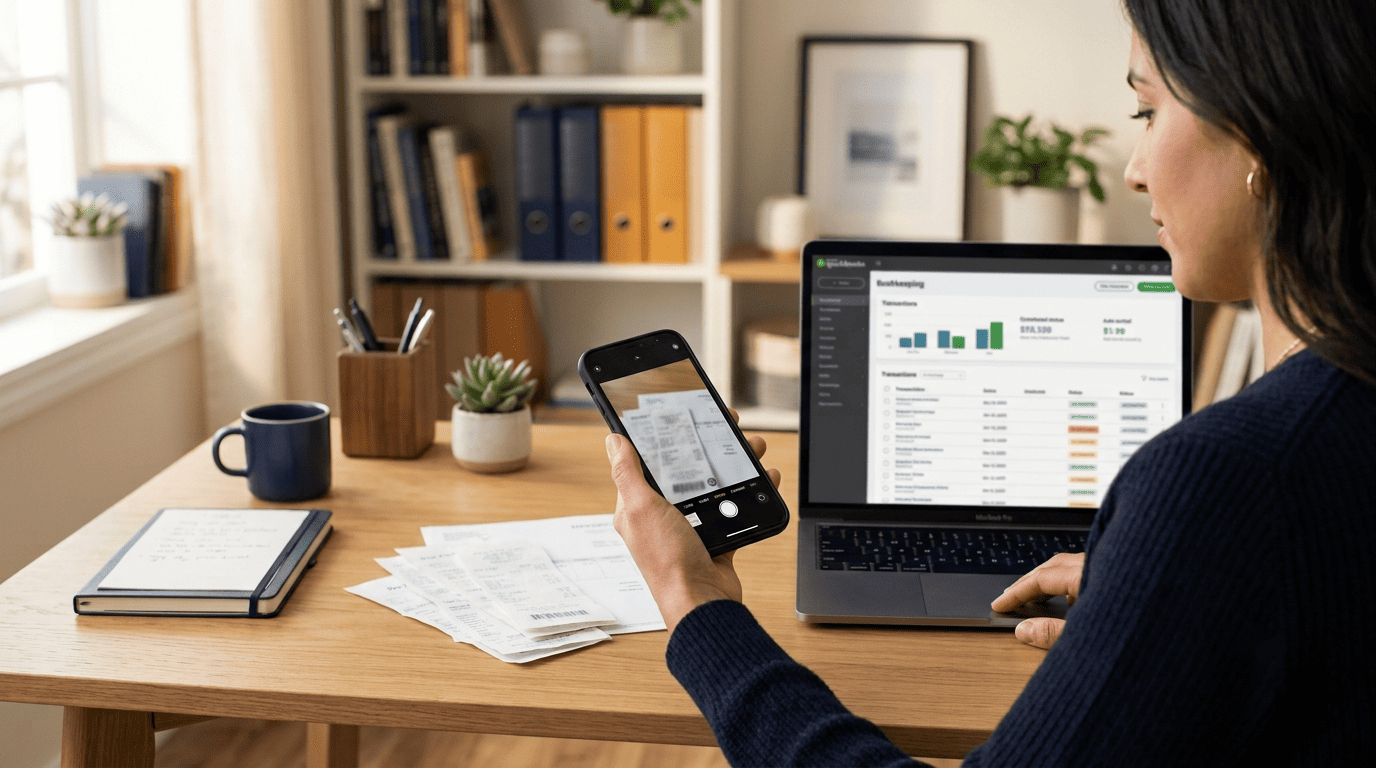
OCR reads scanned or photographed documents and turns them into structured data. Machine learning models categorize transactions and predict where line items belong based on historical patterns. NLP and generative AI draft narrative summaries, answer plain-English questions about the numbers, and generate first-pass reports. All three are forms of pattern recognition applied to accounting data — they identify what data looks like based on prior examples. None of them involves the kind of contextual understanding a professional applies when a transaction doesn’t fit the pattern.
What AI can’t do — and why accountants stay essential
The gap between «automates a task» and «replaces a professional» comes down to three things software doesn’t have: a license to lose, legal liability, and the ability to reliably interpret ambiguity.
Judgment, ethics, and accountability stay with the license holder. Professional skepticism, materiality calls, and ethical gray areas require a human who can be held to a standard and disciplined for getting it wrong. AI has no license to lose and cannot be held liable for a bad call — which means every output still needs a human owner before it goes to a client, a lender, or a regulator.

Messy, inconsistent data resists full automation. Real books are rarely clean. Abigail Parker, a researcher at UT San Antonio, has pointed to heterogeneous data structures across different ERP and accounting systems as a persistent blocker to full automation — AI needs standardized, structured input to perform reliably, and the real world of small-business bookkeeping rarely provides it. Ambiguous transactions and shifting tax rules compound the problem.
Client trust isn’t something software builds. Small-business owners want someone who understands their specific business, explains the numbers in plain language, and advocates for them with a bank or the IRS. That relationship is the reason countio.pro is built as a friendly accounting helper rather than a black-box calculator — the tool handles the busywork, but the trust still runs through a person.
What stays firmly on the human side of the line, regardless of how good the tools get:
- Signing and taking legal responsibility for a filing
- Exercising professional skepticism on an ambiguous transaction
- Making a materiality judgment call
- Advocating for a client in front of a lender, auditor, or the IRS
- Owning the outcome when something goes wrong
How the accountant’s role is shifting toward advisory
As routine work automates, the accountant’s day shifts up the value chain — from producing numbers to interpreting them. That shift shows up clearly in how firms describe where they expect growth, and many firms are already redirecting the hours freed up by AI accounting tools into forecasting, tax planning, and client strategy work instead of ledger cleanup.
From data entry to decision support
Cash-flow forecasting, tax planning, and client advisory services (often shortened to CAS) are where accountants are spending the time that used to go to manual data entry. This isn’t a hypothetical future state — it’s the direction firm structures are already moving, with advisory increasingly billed and marketed as a distinct, higher-margin service line rather than a bonus add-on to compliance work. Among firms in Intuit’s survey that expect their advisory work to grow, 94% believe that growth will translate into higher firm revenue.

New skills that matter
- Data literacy — reading dashboards and AI-generated summaries critically, not just accepting the output.
- AI output review — knowing where a model is likely to be wrong (edge cases, unusual transactions) and checking those first.
- Advisory communication — translating numbers into decisions a business owner can act on.
- Tech fluency — comfort configuring and auditing the accounting software stack, not just using it.
- Continuing judgment training — staying current on standards and rules that AI tools can’t interpret on their own.
The AICPA has been actively pushing to modernize the profession’s skill requirements around exactly this list, treating tech fluency and advisory skill as core competencies rather than optional extras for the next generation of CPAs.
Which accounting jobs are most at risk
Risk from accounting automation isn’t spread evenly across the profession — it’s concentrated in roles built almost entirely around repetitive execution rather than judgment.
Repetitive-execution roles feel it first
The World Economic Forum’s Future of Jobs Report 2025 lists bookkeeping, payroll, and accounting clerk roles among the fastest-declining occupations through 2030, reflecting how much of that work consists of standardized, rules-based tasks that generative AI in accounting and automation software now handle well. That’s a meaningfully different category from CPA or advisory roles, which depend on judgment calls the WEF data doesn’t classify the same way.
The entry-level pipeline concern (balanced)
There’s a real debate worth naming honestly: if firms automate the junior tasks that used to train new accountants — basic reconciliation, first-draft reports, routine categorization — where does the next generation of partners get its foundational experience? Jack Castonguay, who leads strategic content development for accounting, finance, and AI at Surgent, has raised exactly this concern: today’s entry-level staff are tomorrow’s partners and firm leaders, and replacing them outright risks losing more than headcount. The more constructive framing isn’t to eliminate entry-level hiring, but to redesign it: give juniors AI-assisted tasks that build judgment faster, rather than years of pure data entry.
Employment outlook: is accounting still a good career?
What the BLS projects
The Bureau of Labor Statistics Occupational Outlook Handbook projects employment of accountants and auditors to grow 5% from 2024 to 2034 — faster than the average for all occupations — with about 124,200 openings projected each year, on average, over the decade from growth and the need to replace workers who leave the field. These BLS figures are tied to the current projection cycle and are updated periodically, so check the BLS page directly for the latest numbers. The demand for judgment-based accounting work isn’t disappearing alongside the routine tasks that AI absorbs.

Reality check
Put the BLS growth projection next to the WEF’s clerical-decline data and the picture gets more nuanced: the profession overall keeps growing, while the most routine sub-roles within it shrink. Net effect — accounting remains a viable, in-demand career path, especially for people who add advisory and technology skills on top of core technical competence.
What this means for small businesses and freelancers
For a small-business owner or freelancer, the practical question isn’t «AI or accountant» — it’s which tasks go where.
Use AI for the busywork, a human for the judgment
- Let AI accounting software handle day-to-day categorization, receipt capture, and bank reconciliation.
- Use AI-generated dashboards to check cash-flow trends between formal reviews.
- Bring in a licensed accountant for tax strategy and any filing you have to sign and stand behind.
- Escalate anything involving audits, disputes, or unusual transactions to a professional rather than trusting AI output blindly.
- Keep a baseline recordkeeping habit — the SBA’s guide to managing your business finances is a solid starting reference for what records to keep and how.
That division of labor — accounting AI vs accountant — is really a division between busywork and judgment, and it’s the same split experienced accountants describe when explaining how their own workflow has changed.

Getting started sensibly
Keep clean, organized records from day one rather than trying to reconstruct a year of receipts at tax time. Review AI-generated categorizations and reports before relying on them — treat them as a first draft, not a final answer. And know where your own comfort level ends: the moment a question touches tax strategy, an audit, or a filing you’ll be personally responsible for, that’s the moment to bring in a licensed CPA. Everything in this article is general educational information, not tax, accounting, or career advice.